
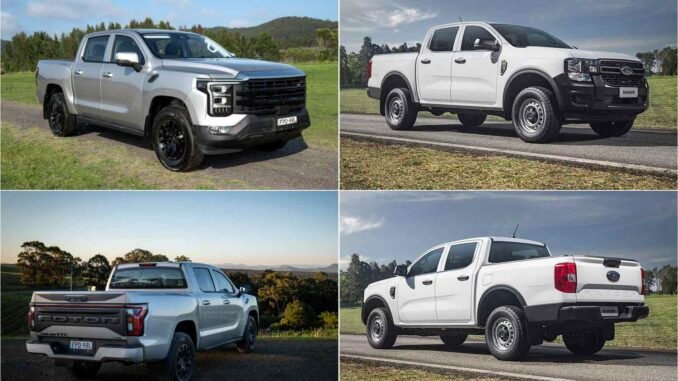
Tunland vs Ranger – At first glance this may seem to be an unusual comparison. That’s because the Foton Tunland is a relatively new Ute to the Australian Market. And the Ford XL isn’t a Ute that gets much publicity, but is popular with tradies, workers etc.
So as work Utes, where buyers need best value for money and reliability, what are these two like, and which one is the better Ute.
The result may just surprise you.
Tunland vs Ranger background
The Foton Tunland was released in Australia in late 2025. It comes in both work oriented V7 and a more recreational focused V9 versions.
The latest Ford Ranger was released in mid-2023 sometime. This latest model is substantially better than the previous model. The XL is the entry level model, aimed at workers.
Lets look at the similarities and why it’s a good comparison.
- Both Utes are dual cab pickup style.
- Both these Utes are rear wheel drive work Utes.
- They have a 2.0 L single turbo diesel engine (48V mild hybrid for the Tunland)
How much do these Utes cost and owner benefits?
The Foton Tunland costs $39,990 and the Ford Ranger cost $43,530. Both prices are MLP*
So straight up front there is some $3,500 dollars difference. The Ford is around 9% more expensive. At this pricing that’s a fair chink of change.
On top of that the Foton has a longer warranty and roadside assist period. However, the Ford does have unlimited kilometre warranty. If you are doing lots of kilometres that may be beneficial.
Its too early to determine the resale value of the Tunland. Best estimates would put that at about 50% after five years. But the Ford would have an estimated retained value of 65% after five years.
| Foton | Ford | |
| Tunland | Ranger | |
| V7-C 4X2 | XL 4X2 | |
| Owner Benefits | ||
| Model Price *MLP | $39,990 | $43,530 |
| Warranty years | 7 years | 5 Years |
| Warranty KM | 110,000 Km | Unlimited Km |
| Road side assist | 1 year conditional | 1 year conditional |
| Servicing | Capped $ 7 yrs. 110,000 km | Fixed $ over 4 services |
- RDAP* is Recommended Drive Away Pricing based on manufacturers pricing or location
- MLP* – Manufacturers List Price includes GST and LCT but excluding statutory charges,
- dealer costs and dealer delivery. See your dealer for RDAP. Does not include price of any options.
- Some features mentioned in the article may be options.
Tunland Vs Ranger – what do they look like
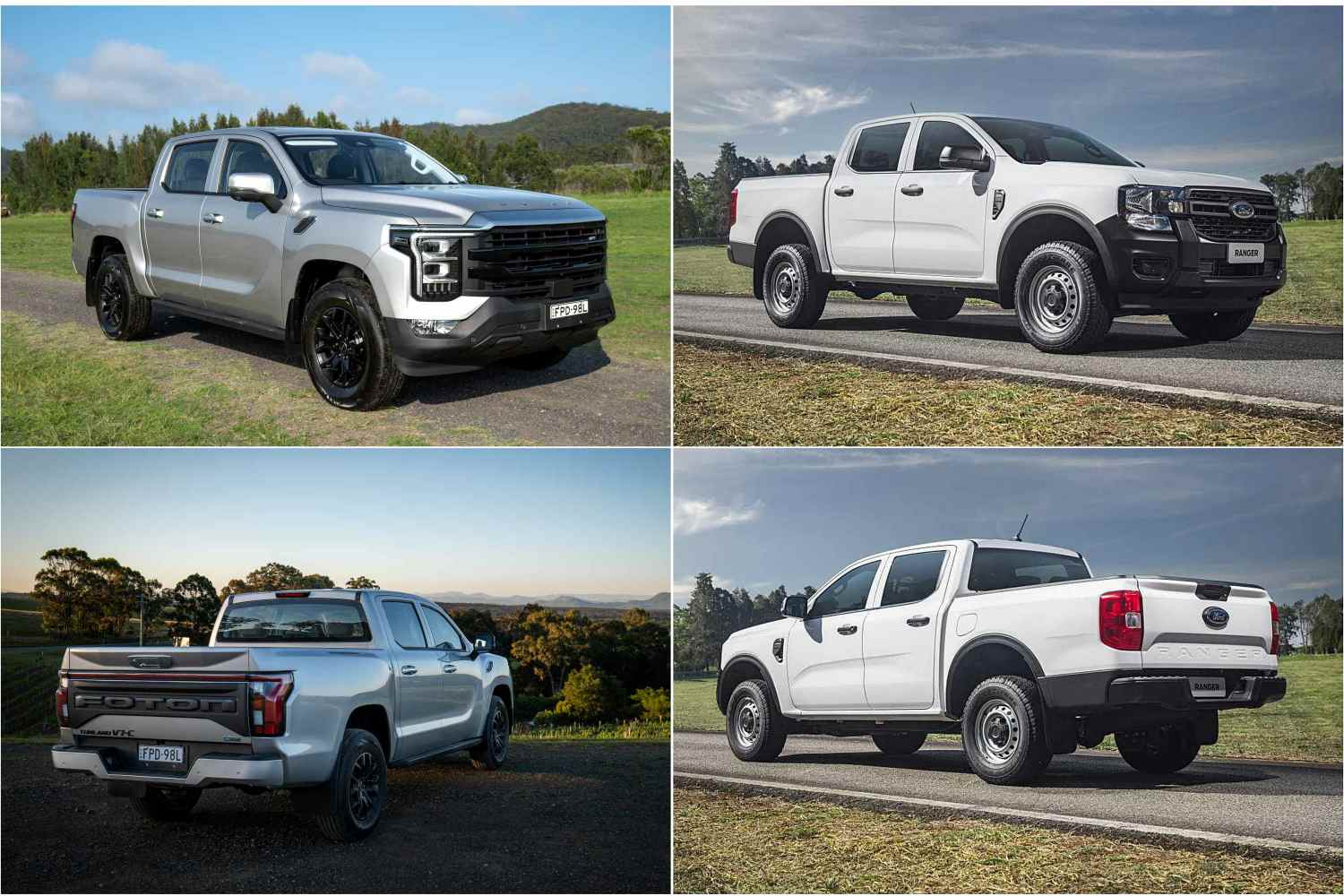
These vehicles have a distinctly different approach to styling.
With a plain exterior style, the Ranger looks like a basic work Ute. Having a simple black grill, halogen headlights, steel wheels and almost a plain jane appearance.
Work Utes are often called the whitegoods section of the market. And with a plain white exterior colour the Ranger certainly lives up to that naming.
It’s simple, clean and work oriented.
However, the Tunland has a bigger, bolder, more American Pickup truck styling. It certainly stands out. With a wide stance, sculpted body lines and prominent wheel arches that create an aggressive and modern design.
The tall, bold grill with vertical stacked LED headlights takes on a muscular appearance.
From the profile view, again the Ranger has a plain simple design. While the Tunland has bulging wheel arches, more details lines and a higher stance.
At the rear, the Tunland V7 continues its modern styling with distinctive LED tail-lights and a contemporary tailgate design, while the Ranger XL keeps a straightforward, functional appearance that reflects its role as a dependable work Ute.
Overall, the Foton Tunland V7 is aimed at buyers who want a Ute with bold styling, premium visual features and a strong road presence. The Ford Ranger XL, by contrast, prioritises a practical design that appeals to tradespeople and fleet buyers.
Styling is a personal thing but for me the Tunland takes the prize here.
Some External features at a glance:
| Foton | Ford | |
| Tunland | Ranger | |
| V7-C 4X2 | XL 4X2 | |
| External Features | ||
| Headlights | LED | Halogen |
| High Beam Assist (HBA) | Y | N |
| DRL | LED | Halogen |
| Auto dusk sensing / HB | Y | Y |
| Steering Responsive Headlights | Y | N |
| Fog lights | LED | N |
| Height adjustable headlights | Y electronic | N |
| Roof Rails | N | N |
| Side mirrors | electronic / folding | electronic |
| Sun Roof | N | N |
| Auto wipers | Y | N |
| Tailgate assist | N | Y |
| Tub Bedliner | Y | N |
| 240V outlet in Tub | Y | N |
Tunland Vs Ranger – what are they like inside.
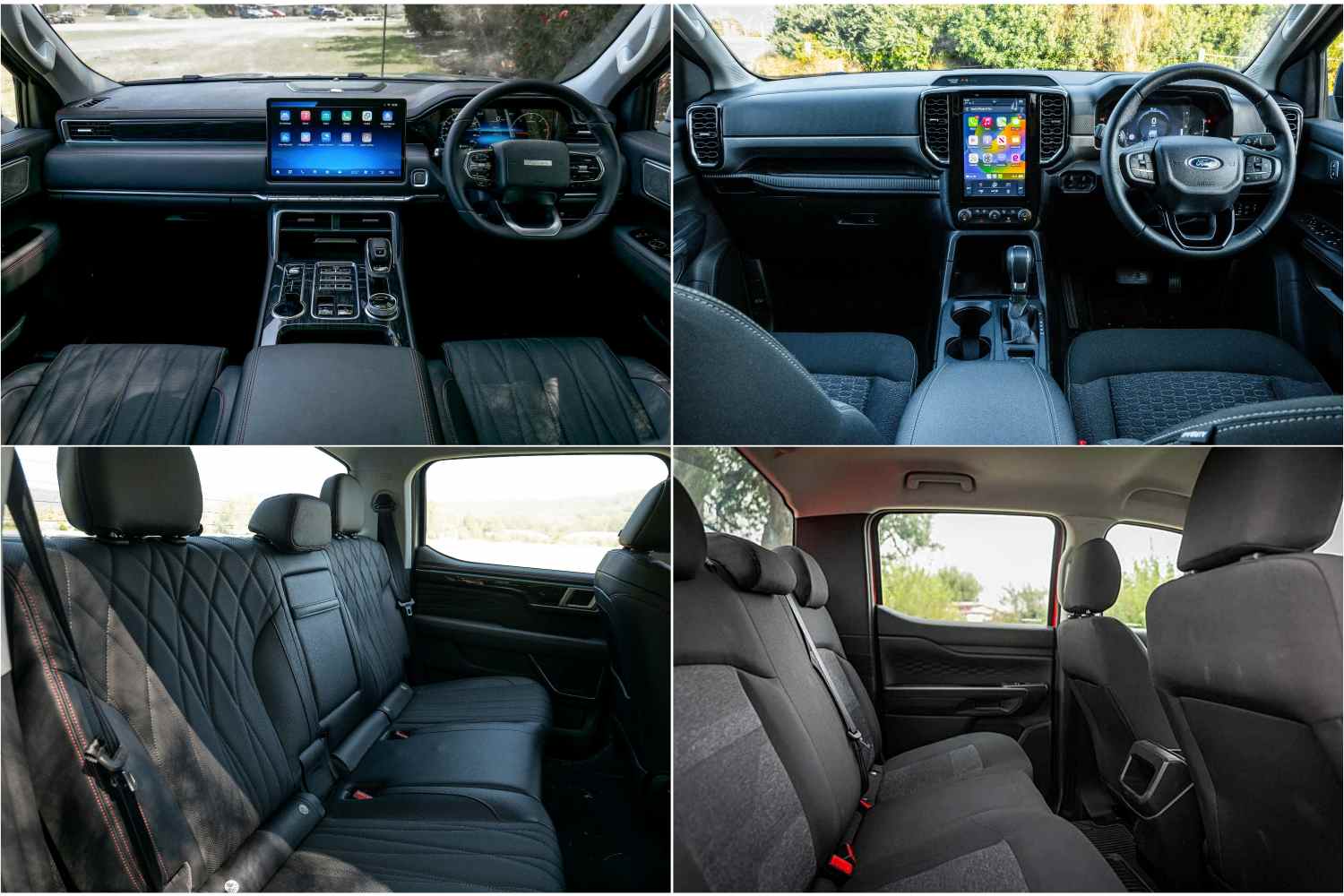
These vehicles have completely different approaches to interiors design.
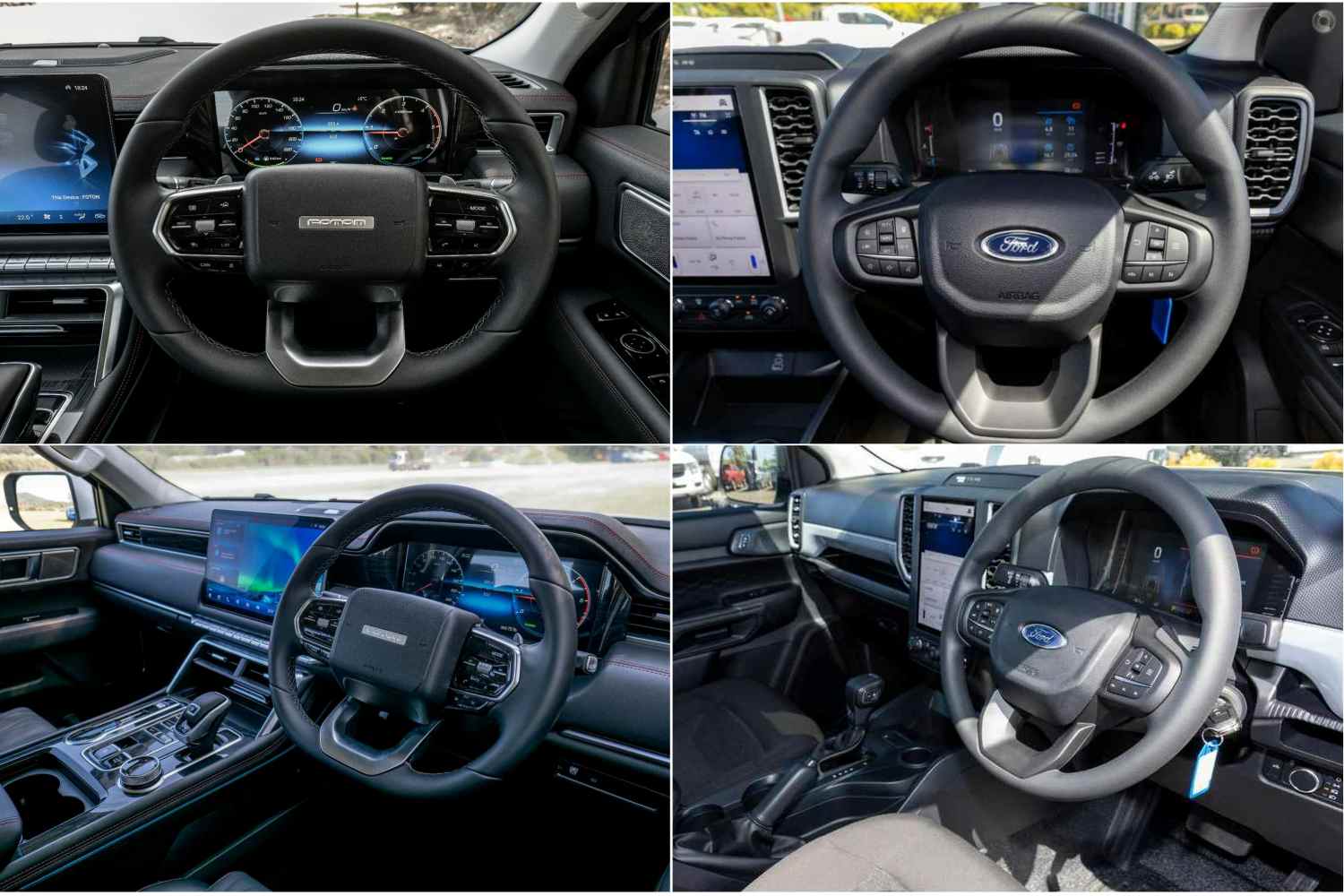
The Foton Tunland V7 offers an interior that is designed to feel more like a modern SUV than a traditional work Ute. The cabin features a contemporary layout with a large central touchscreen, a fully digital instrument cluster and a wide centre console that gives the interior a premium appearance.
Soft-touch materials, leather-accented trim on higher grades, metallic finishes and contrast stitching contribute to a more upmarket feel than many entry-level utilities.
The seats are generously sized and provide good support for long-distance driving, while the spacious cabin offers ample headroom and legroom for both front and rear passengers.
There is enough room for five normal sized adults to sit in comfort in the Tunland.
Storage solutions are also practical, with large door pockets, cup holders and a sizeable centre console.
In comparison, the Ford Ranger XL has a more functional and work-focused interior. While it incorporates modern technology, including a digital instrument display and a portrait-style infotainment screen in newer models, the cabin uses harder-wearing materials that are designed to withstand heavy daily use.
The overall layout is straightforward, with controls positioned for ease of operation while wearing work gloves or driving in demanding conditions. Cloth seats, durable plastics and simple trim finishes reinforce the XL’s role as an entry-level commercial vehicle.
Passenger comfort or durability
The Tunland V7 places greater emphasis on passenger comfort and visual appeal, making it feel more refined for family use or long highway trips. Features such as a leather-wrapped steering wheel, premium upholstery options and higher-quality interior finishes create a more luxurious atmosphere than expected in this segment.
By contrast, the Ranger XL prioritises practicality and durability over luxury. Its interior is easy to clean, resistant to wear and designed to handle the demands of worksites and fleet operations.
Although it may not feel as premium as the Tunland V7, it offers excellent ergonomics, logical storage and Ford’s well-developed cabin design.
Overall, the Foton Tunland V7 provides a more stylish and comfort-oriented interior, while the Ford Ranger XL focuses on rugged functionality, making it particularly well suited to buyers who need a dependable work vehicle that can withstand years of heavy use.
The Foton Tunland is more luxurious, comfortable and spacious.
Foton Tunland takes the prize here
Interior features at a glance
| Foton | Ford | |
| Tunland | Ranger | |
| V7-C 4X2 | XL 4X2 | |
| Internal Features | ||
| Leather or cloth seating | Leather | Cloth |
| Electronic drivers seat | N | N |
| Additional Driver Lumbar Support | N | N |
| Electronic Passenger seat | N | N |
| Reach and Tilt adj steering | Y | Y |
| Steering wheel controls | Y | Y |
| Heated Steering wheel | N | N |
| Heated front seats | N | N |
| Cooled front seats | N | N |
| Heated rear outer seats | N | N |
| Isofix / top tether | 2 of each | 2 of each |
| Floor covering | carpet | vinyl |
| A/C Climate Control/Zoned | Y/dual | Y/dual |
| A/C Rear vents/controls | Y/N | Y/N |
| Auto dimming rear view mirror | N | N |
| Power windows | Y | Y |
| Sat Nav | Y | N |
| Audio/infotainment | 4 Speaker | 4 Speaker |
| MFD in instrument binnacle | 12.3 “ | N/A |
| Driver Instruments | 12.3 ” digital | 8.0 inch |
| Centre stack screen | 14.6 ” touch | 12.0 “touch |
| 12V/USB Outlets | 1 x 12V / 4 USB-A | 1/4 USB |
| 220V/300W Power Socket | Y | Y 400 W |
| Android / Apple play | Wired / Wireless | Wireless |
| Fast Wireless phone charging (Qi) | Y | N |
| Push button start | Y | N |
| Colour HUD with digital speedometer | N | N |
| Sound Mood Lighting | Y | N |
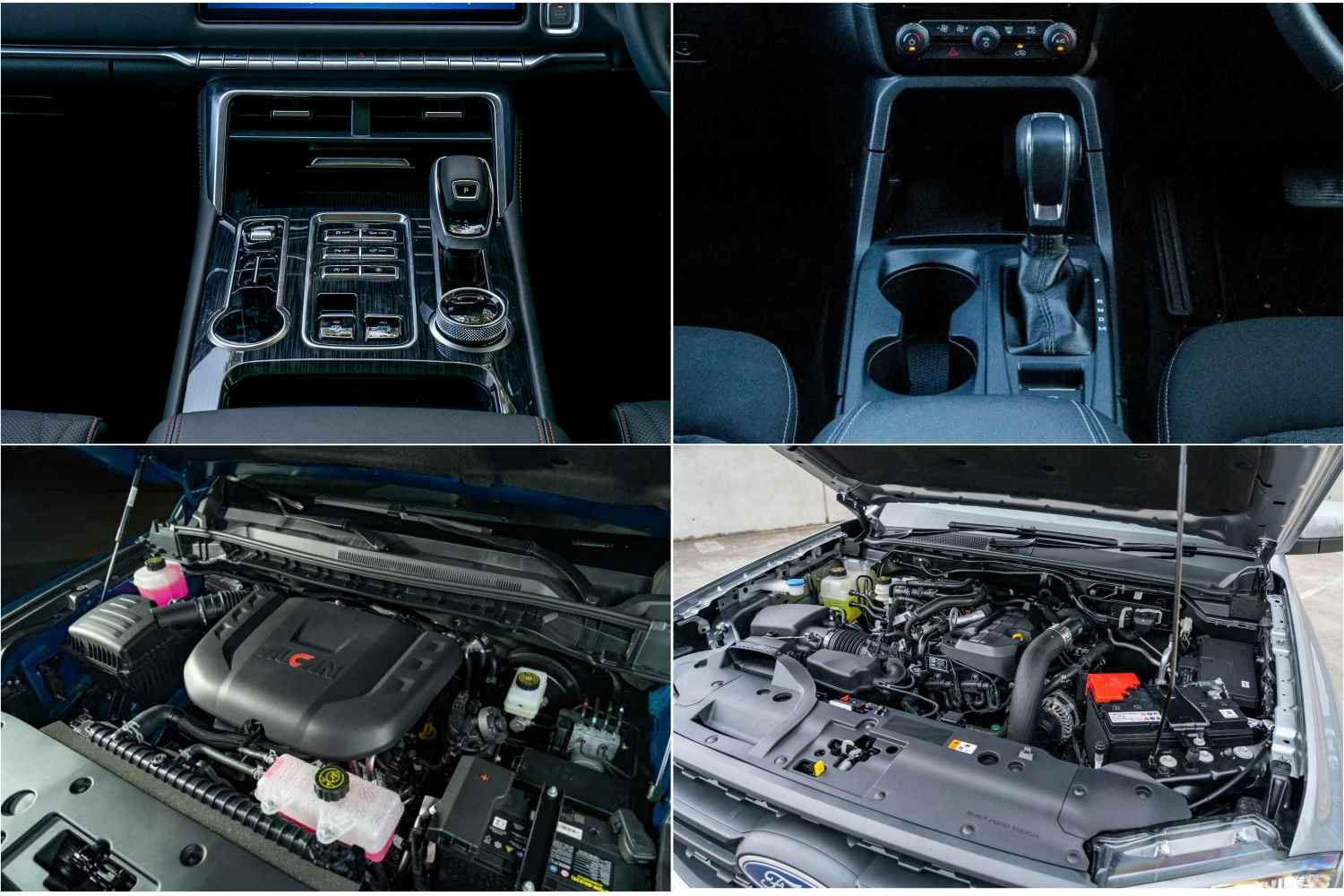
Tunland vs Ranger – Engine and transmission.
Both these Utes have a 2.0L single turbo diesel 4 cylinder engine. They have similar power figures.
The Tunland 48V hybrid system provides some 12% more torque and that combined with the eight speed ZF automatic transmission provides the edge.
Engine and transmission details.
| Foton | Ford | |
| Tunland | Ranger | |
| V7-C 4X2 | XL 4X2 | |
| Engine | 2.0L 4 Cyl Turbo Diesel | 2.0L 4 Cyl Turbo Diesel |
| Hybrid | 48V mild hybrid | N |
| Euro rating | Euro 6e | Euro 5 |
| Drivetrain | 8 SP AT | 6 Sp AT |
| 4WD System | N/A Rear Wheel Drive | N/A Rear Wheel Drive |
| Drive Mode Select | Y / 3 Modes | N |
| Rear Diff locks | N | N |
| Front Diff locks | N | N |
| Power | 120 kW @ 3600 rpm | 125 kW @ 3500 rpm |
| Torque | 450 Nm @ 1500 – 2400 rpm | 405 Nm @ 1750 – 2500 rpm |
| Safety | Not Rated | 5 star ANCAP |
| 0-100kmh / Top Speed | TBA | TBA |
| CO2 Emissions | 211 g/km | 186 g/km |
| Economy ADR | 8.0 L/100km | 7.1 L/100km |
| Economy on test | 8.5L/100k | 8.6 L/100km |
| Max Range | 1041 km | 1231 km |
| Range on test | 850 km | 850 km |
| Fuel tank capacity | 76 L | 80 L |
| Servicing | 12 mth / 20,000 km | 12 mth / 15000 km |
What are they like to drive?
The Foton Tunland V7 and Ford Ranger XL are both built to handle the demands of Australian roads, but they deliver noticeably different driving experiences. While each is capable, their suspension tuning, steering characteristics and overall refinement reflect different design priorities.
The most noticeable difference between them is that the Ranger is a basic work Ute with a slightly harsher ride unladen. It has that unmistakable work Ute ‘bounce’ at times .
The Tunland is more SUV like with a quieter, smoother and more complaint ride. It will still carry the heavy loads, but the ride and handling is more refined than the Ranger.
Foton Tunland V7
The Foton Tunland V7 has been developed with a stronger emphasis on comfort than many traditional work Utes. Its suspension is tuned to absorb bumps and uneven road surfaces effectively, providing a smoother ride during everyday commuting and long-distance highway travel.
The cabin remains relatively quiet and composed over rough bitumen, with less of the harshness commonly associated with vehicles that use rear leaf springs. This makes the V7 well suited to buyers who plan to use their Ute as both a work vehicle and a family car.
The longer wheelbase also contributes, with less bounce and more stability, helping the vehicle feel settled at highway speeds.
Steering in the Tunland V7 is light and easy to operate, making low-speed manoeuvring and parking relatively effortless despite the vehicle’s large dimensions. Around town, the steering requires minimal effort, while on the open road it offers predictable responses that inspire confidence. It delivers a comfortable and relaxed driving experience that suits everyday use.
Ford Ranger XL
The Ford Ranger XL, by comparison, has earned a reputation as one of the best-driving Utes in its class. Ford invested significant engineering resources into the Ranger’s chassis, suspension and steering, resulting in handling that feels more composed and car-like than many other rivals.
The front suspension absorbs road imperfections well, while the rear suspension has been carefully tuned to provide a balance between load-carrying ability and ride comfort. Even when unladen, the Ranger remains reasonably stable and controlled over corrugated roads, potholes and uneven surfaces.
One of the Ranger XL’s biggest strengths is its steering. It offers precision and feedback making the vehicle feel easier to position on winding roads and more confident at higher speeds. Body roll is well controlled for a vehicle of its size, and the chassis maintains good composure through corners, even when carrying moderate loads.
When carrying heavy loads or towing, the Ranger XL suspension is designed to maintain stability under load, reducing body movement and improving control when hauling equipment or towing trailers.
Overall thoughts
Overall, the Foton Tunland V7 offers a comfortable, refined and easy-to-drive experience that will appeal to buyers looking for a modern Ute with everyday comfort and a relaxed driving character. It will embrace more enthusiastic driving, if wanted.
The Ford Ranger XL, however, previously set a benchmark for ride and handling in the Ute segment, combining excellent steering precision, impressive suspension tuning and outstanding stability both on and off the road.
What about towing
Both Utes are rated to tow 3500kg with a 350kg tow ball rating as mentioned. Neither Ute should tow that weight for long periods of time.
With heavy loads the Tunland will perform better. It has some 12% more torque, coming at a lower rpm. With the 49V mild hybrid and 8 speed ZF Transmission, the Tunland can access more of its power and torque when needed.
The longer wheelbase and wider track also assist with providing a more stable towing experience.
Both vehicles are equipped with additional towing aids.
It’s a close call but the Tunland takes the win here.
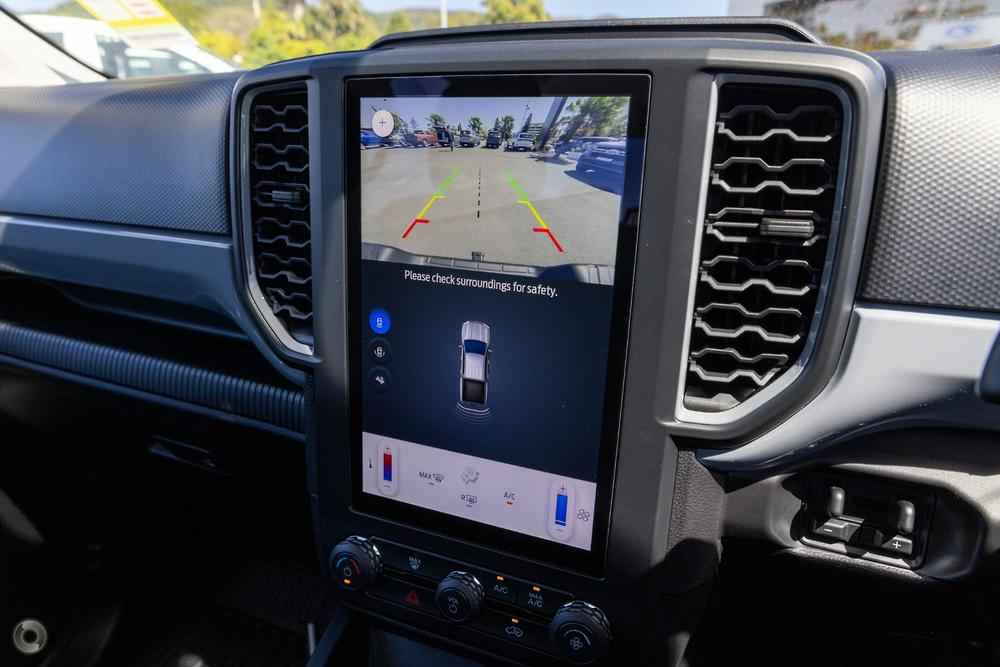
Tunland vs Ranger – What about Safety
The Foton Tunland V7 and Ford Ranger XL both offer a comprehensive range of safety features, but they differ in their focus and level of driver assistance technology.
The Tunland V7 has been designed to compete with more established Utes by including a broad suite of advanced safety systems as standard.
The Ford Ranger XL also provides a strong level of safety, benefiting from Ford’s extensive experience in vehicle development and testing.
One advantage of the Ranger XL is that it is built on a platform that has undergone extensive crash testing and has earned a 5-star ANCAP safety rating, demonstrating strong occupant protection and crash performance.
At the time of writing, buyers should confirm the latest independent crash test results for the Tunland V7.However the Tunland has all the necessary safety features to attain a similar rating.
As far as safety goes it’s a tie for both Utes.
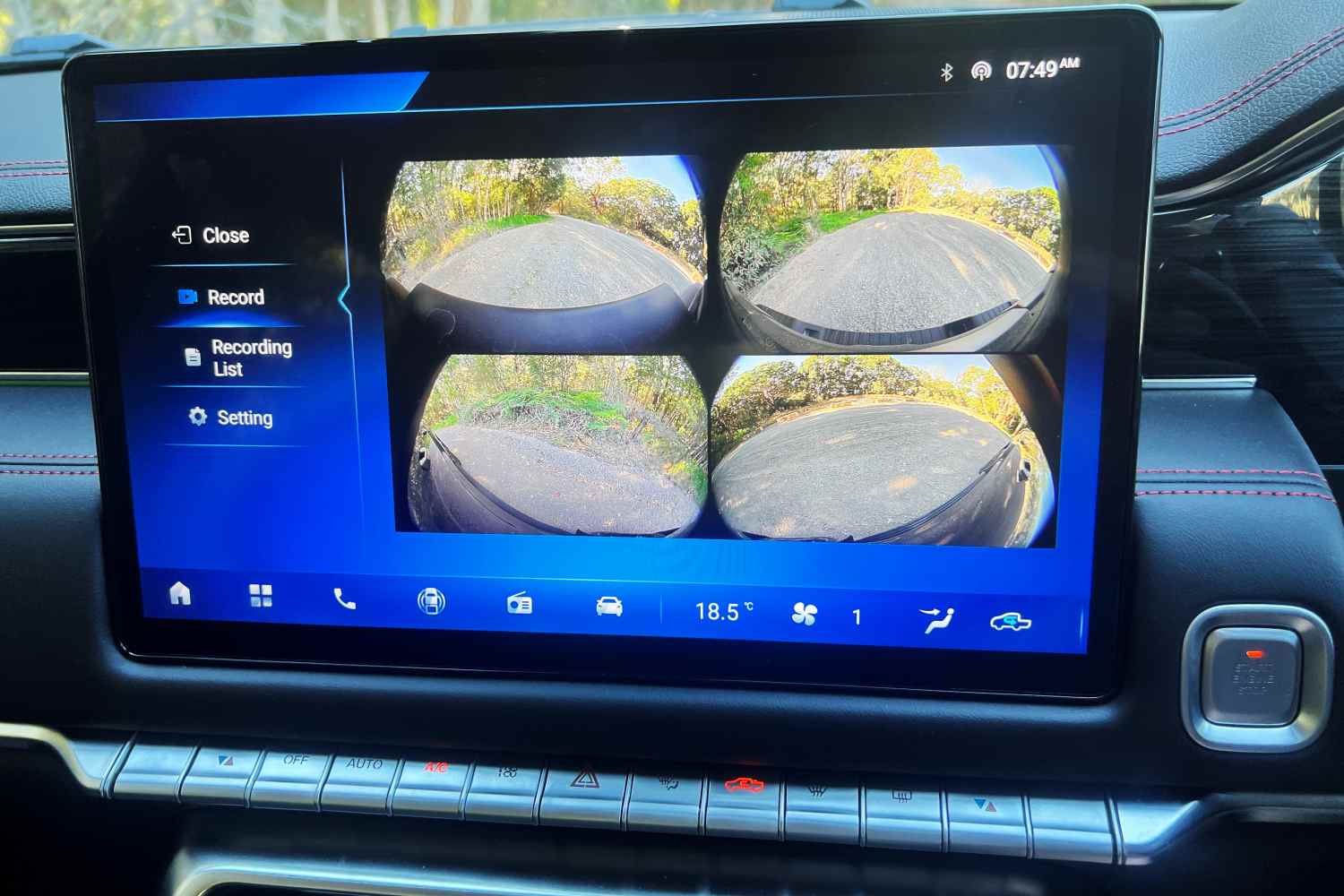
Safety Features at a glance
| Foton | Ford | |
| Tunland | Ranger | |
| V7-C 4X2 | XL 4X2 | |
| Safety | ||
| ANCAP | N/A | 5 Star |
| Anti-skid Brake System (ABS) | Y | Y |
| Electronic Stability Control (ESC) | Y | Y |
| Electronic Brakeforce Distribution (EBD) | Y | Y |
| Traction Control System (TCS) | Y | Y |
| Emergency Brake Assist (EBA) | Y | Y |
| Active Torque Vectoring system | N | N |
| Active Yaw control | N | N |
| Auto Vehicle Hold (AVH) | Y | Y |
| Electronic parking brake | Y | N |
| Roll Over Mitigation (ROM) | N | N |
| Pedestrian alert system | Y | Y |
| Driver Attention Alert | Y | Y |
| Driver Monitoring System | Y | Y |
| Autonomous Emergency Brake (AEB) | Y | Y |
| Rear AEB | Y | Y |
| Automatic post collsion braking | Y | Y |
| Forward Collision Alert (FCA) | Y | Y |
| Cyclist/pedestrian detection | Y | Y |
| Lane Departure Warning (LDW) | Y | Y |
| Lane Change Assist (LCA) (LKA) | Y | Y |
| Emergence Lane Keep Assist | Y | Y |
| Tyre Pressure Monitoring | Y | N |
| Trailer Sway Control (TSC) | Y | Y |
| Integrated Trailer braking | N | N |
| Hill Start Assist (HSA) | Y | Y |
| Hill Descent Control (HDC) | Y | Y |
| Blind spot warning | Y | Y |
| Rear Cross Traffic Alert (RCTA) | Y | Y |
| Front Cross Traffic Alert (FCTA) | Y | Y |
| Reverse Automatic Braking (RAB) | Y | Y |
| Driver & front passenger SRS airbags | Y | Y |
| Driver & front passenger side SRS airbags | Y | Y |
| Curtain SRS airbags | Y | Y |
| Driver knee airbag | Y | Y |
| Reversing camera | Y | Y |
| Surround view monitor | Y | N |
| Rear park assist sensors | Y | Y |
| Front Park assist sensors | Y | Y |
| Parking collision avoidance | Y | Y |
| Remote Smart Parking Assist | Y | Y |
| Side anti-intrusion bars inside all doors | Y | Y |
| Engine immobilizer | Y | Y |
| Anti-theft alarm | Y | Y |
| ISOFIX child restraint anchor point | Y /2 | Y / 2 |
| Top tether points | Y/2 | Y / 2 |
| Safety Power window | Front | Front |
| Selective Adaptive cruise control | N | N |
| Intelligent speed limiter | Y | Y |
| Traffic sign recognition | Y | Y |
| Overspeed alert | Y | N |
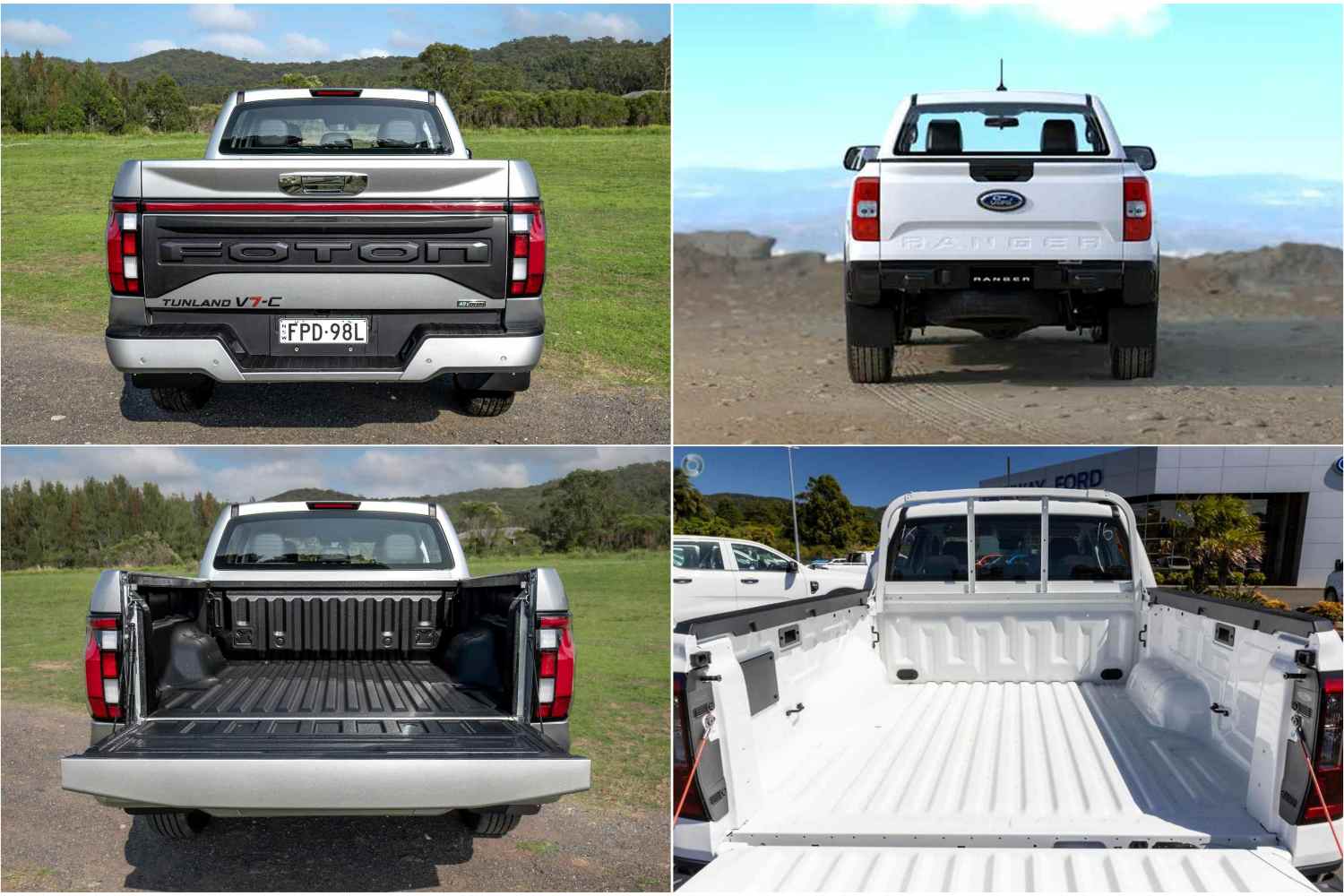
Tunland VS Ranger – What are the dimensions like
Both the Foton Tunland V7 and Ford Ranger XL designers designed them as dual-cab utility vehicles capable of handling demanding work and recreational duties, but they differ in their dimensions and payload capabilities. These differences influence everything from cabin space and road presence to carrying capacity and practicality.
The Foton Tunland V7 is one of the larger vehicles in the Ute segment. Its generous dimensions give it a commanding presence on the road and contribute to a spacious interior for both front and rear passengers. The long wheelbase improves rear-seat legroom and enhances stability when travelling on highways or towing heavy loads. The wider body also provides a substantial stance that appeals to buyers looking for a modern, full-size appearance.
The Ford Ranger XL dual-cab is slightly more compact. While the Ranger is smaller overall, its dimensions still offer impressive load-carrying performance. The slightly shorter wheelbase can also improve turning ability on tighter tracks and work sites.
Tray dimensions are another important consideration. The Tunland V7 provides a practical cargo tub suitable for transporting tools, building materials and recreational equipment, while the Ranger XL’s tub does maximise usable space.
Both vehicles will accommodate a standard Australian pallet between the wheel arches, making them particularly practical for commercial operators.
Payload capacity does vary slightly.
Foton Tunland V7 offers a payload of approximately 1116kg. This capacity is suitable for most everyday work tasks, camping equipment, motorcycles or recreational gear.
The Ford Ranger XL offers a payload capacity of a claimed 1075kg. This payload allows tradespeople and fleet operators to transport tools, equipment and materials while remaining within legal load limits.
Both vehicles have a heavy duty suspension arrangement to accommodate the heavy loads.
Both vehicles offer a 3,500 kg braked towing capacity; however, I wouldn’t want to be towing that weight for long distances in either Ute.
It’s worth noting that while the Ranger has a 3500kg towing rating the difference between GVM and GCM means that owners wont be able to carry a full payload and tow 3500kg.
The Tunland on the other hand will carry maximum GVM and an additional 3500kg.
Both are in theory, again 3500 kg is a lot of weight for both to be towing with smaller engines.
Overall, the Foton Tunland V7 impresses with its larger overall dimensions, spacious cabin and bold road presence, making it an attractive option for buyers seeking comfort and modern styling.
The Ford Ranger XL, however, provides a balanced package for heavy-duty work, offering excellent cargo practicality and dimensions that are easier to manage in both city driving and demanding job-site conditions.
Foton Tunland is the winner here.
Dimensions at a glance
| Foton | Ford | |
| Tunland | Ranger | |
| V7-C 4X2 | XL 4X2 | |
| Dimensions | ||
| Overall Length mm | 5617 | 5370 |
| Wheelbase mm | 3355 | 3270 |
| Width mm | 2000 | 1918 |
| Height mm | 1910 | 1875 |
| Wheels | 18 x 7.5 Alloy | 16 x 7.0 steel |
| Tyres | 265/70 R18 | 255/70 R16 |
| Full size spare | Y | Y |
| Brakes front | Disc | Disc |
| Brakes rear | Disc | Drum |
| Track front mm | 1700 | 1620 |
| Track rear mm | 1700 | 1620 |
| Max ground clearance mm | 240 | 234 |
| Wading Depth mm | 700 | 800 |
| Approach degrees | 28 | 29 |
| Rampover degrees | 21 | 20 |
| Departure angle degrees | 26 | 25 |
| Turning Circle KTK m | 13.5 | 12.9 |
| Tub Length mm | 1577 | 1547 |
| Tub width arches mm | 1240 | 1224 |
| Tub width mm | 1650 | 1584 |
| Tub Depth mm | 530 | 529 |
| Kerb Weight kg | 2189 | 2175 |
| Payload (kg) | 1116 | 1075 |
| GVM (kg) | 3305 | 3250 |
| GCM kg | 6805 | 6200 |
| Towing Capacity (braked) kg | 3500 | 3500 |
| Tow Ball rating kg | 350 | 350 |
| Maximum Front Axle Load kg | 1490 | 1450 |
| Maximum Rear Axle Load kg | 1930 | 1959 |
| Suspension front | Heavy duty | Heavy Duty |
| Suspension rear | Heavy duty | Heavy duty |
| ^ best estimates |
Tunland vs Ranger final thoughts
Foton Tunland is definitely worth a drive if you are in the market for a new work Ute.
As mentioned, it may seem like an odd comparison. But as experience shows, it’s a good comparison.
The Ranger is obviously a popular Ute, always in the top ten sales every month, often topping them. However, that is for the more popular dual cab 4WD recreational Utes.
Work Utes are different. They need to work every day.
For astute buyers, the Foton Tunland V7 is an excellent alternative.
Foton Tunland V7-C 4X2 dual cab Ute is:
- more stylish,
- with more internal space and
- will accommodate five adults in comfort.
- It has more payload and GCM capacity.
- The tub is larger.
- The engine has more useable torque for heavy loads and
- Its less expensive.
7 Trackbacks / Pingbacks
Comments are closed.